

Between Work and the Future: What DYA Argentina's Seminar on Rural Adolescence in Tucumán Revealed
June 12, 2026. On World Day Against Child Labor, DYA Argentina presented the results of the Survey on secondary school students about adolescent work in Tucumán 2025 in a virtual seminar that brought together researchers, rights specialists, and territorial leaders. The results were presented by Bianca Musante, DYA's research and monitoring coordinator, and discussed by Gabriela González (UNT), Daniel Hernández (CIAS), and Julieta Santillán Juri (ANDHES). The closing was led by Betina Castro, DYA's territorial coordinator in Tucumán, and Lis Ogas, a former Youth Hub participant.
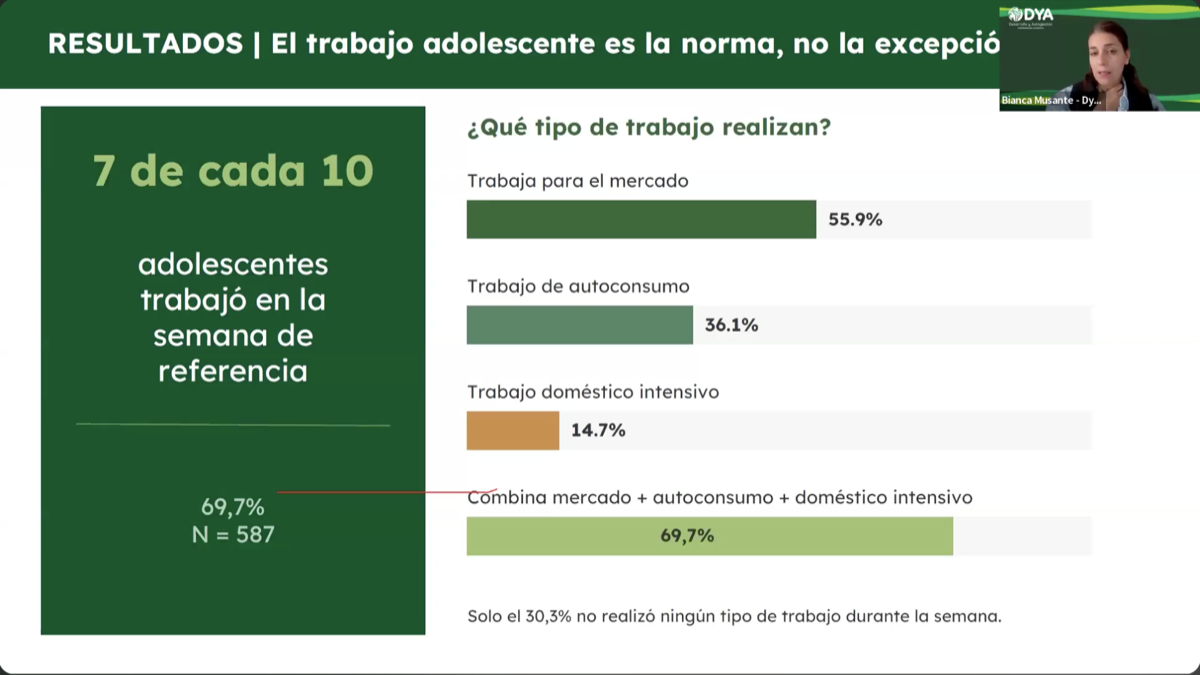
7 out of 10 adolescents in rural secondary schools perform some form of work: market, self-construction, or intensive domestic work
Argentina has no updated national data on child and adolescent work since 2016. To fill this gap, DYA Argentina conducted its own survey in 2025 with 587 adolescents from five rural secondary schools in Tucumán, where the organization has been working for nine years on child care, school support, and job training projects.
The most striking finding is that 7 out of 10 adolescents reported having worked during the week the survey was conducted. These are not isolated cases or extreme situations: this is the everyday reality of most young people sitting in those classrooms. When comparing the educational trajectories of those who work and those who don't, the type of work matters. Market work affects the present: it deteriorates daily study conditions. Self-construction and intensive domestic work affect educational history: it is associated with accumulated interruptions throughout the trajectory. Not all types of work affect schooling in the same way, and this distinction is key to designing responses.
Regarding educational trajectories, the survey shows that low academic performance —low grades and pending subjects— is a widespread phenomenon affecting 64% of adolescents regardless of whether they work or not. Additionally, 54.5% remain in school without repeating or dropping out, but study under conditions that compromise their real right to learn (without time to study and with many absences). "Staying in school doesn't guarantee being in a condition to learn," warned Musante, who called this group "the invisible: young people the system records as regular students, but who are far from being able to fully exercise their right to education."
A methodological warning amplifies the severity of all the above, since the survey only reaches those inside the school. Those who dropped out due to work were not surveyed. "We are probably underestimating the magnitude of the problem," the researcher acknowledged.
Territory as a key to reading the data
Gabriela González from the National University of Tucumán (UNT) provided the historical and structural dimension that helps understand why these communities are what they are. The studied areas (Famaillá, Santa Lucía, Teniente Berdina) have been marked for decades by the closure of sugar mills in the 1960s, a process that dismantled the region's productive, social, and cultural structure and from which, in many ways, they still have not recovered.
From a Bourdieu-based perspective, González called to avoid readings that individualize the problem: "There is a tendency toward voluntarism: if you want to, you can; the one with merit is the one who makes it. This ends up blaming and discouraging young people, and is a very neoliberal approach we should try to avoid." The capital accumulated by families (economic, social, cultural) is not an individual decision but the result of decades of structural conditions. And it is these conditions, not the adolescents' willpower, that determine how much distance exists between them and opportunities.
Broken narratives: when the future no longer seems possible
Daniel Hernández from the CIAS University Institute brought his research with young people from popular neighborhoods in the Buenos Aires metropolitan area, drawing parallels that expanded the debate beyond Tucumán. His central concept was "broken narratives of social ascent": the story that organized life in Argentina (growing up, studying, getting a job, forming a family) is losing credibility among young people from popular sectors. "There are kids of 17, 18, 19 who say: I no longer have a future," noted Hernández.
When that narrative weakens and socialization spaces shrink, other structures take their place. Some of them border on or are directly illegal. "An example is small-scale drug dealing," Hernández warned, "it offers income, work, and a place of social recognition," becoming the organization with the lowest barriers to entry for young people. It is not an anomaly, but rather the result of decades of institutional deterioration that exceeds any particular government. Hernández argued that the public policy proposal should be to move from income transfers to rebuilding the fabric where young people grow up: "We need better schools, better clubs, places organized by adults where kids can be recognized, be seen, explore who they are."
School as a space for rights (and its limits)
Julieta Santillán Juri from the NGO ANDHES valued the research for something beyond numbers from a human rights perspective: "This research does not deny difficulties, but it also does not reduce the entire experience to deficit or harm," and she argued that this starting point matters: "Looking at adolescents as rights holders, not as passive victims."
Anchored in the Convention on the Rights of the Child and the principle of progressive autonomy, she argued that school has an irreplaceable function as the space where "waiting, collective projects, and the right to imagine a future not dictated exclusively by market rules" are still possible. But that function has a limit that cannot be ignored: school cannot on its own resolve the social inequalities that affect children and adolescents. Santillán Juri closed with an open question for further reflection: how do we get the rights-based approach to move from being a theoretical framework to being the real engine of transformation in the quality of life of entire communities?
The voice that wasn't in the data
The seminar's closing featured the voice that resonated most at the meeting. Betina Castro, DYA's territorial coordinator in Tucumán, presented the Youth Hubs, programs DYA has been promoting in several communities since 2020 as spaces of real support, since they are free, sustained by a team with years of experience, and often the only alternative to the streets for adolescents who combine school with daily work.
Then Liseth Ogas spoke, a former Youth Hub participant. She arrived at the Youth Hub at 16 looking for math support. She found music, emotional support, and a vocation she didn't know she had. "For me, who found music very distant, it was tremendous," she recounted. This year she graduates as a music teacher, and she added: "That's where I found my identity and who I want to be and where I want to go."
Her testimony is not a decorative closing. It is the most concrete demonstration of what the report describes in figures: that the conditions in which adolescence is experienced largely determine the possibilities that open up toward the future. And that when those conditions improve, even in a Youth Hub in a rural community in Tucumán, horizons transform.